

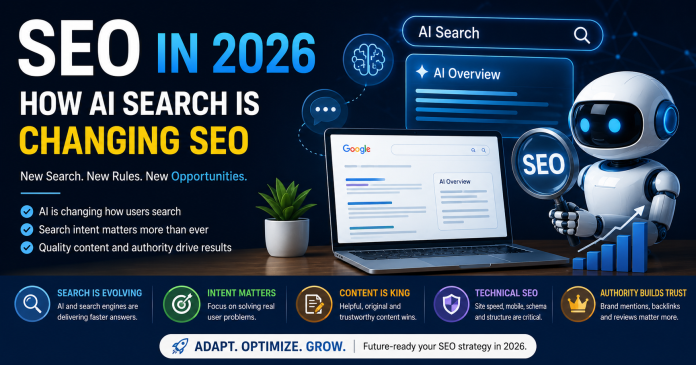
SEO in 2026: Does AI Search Change the Way Businesses Should Do SEO?
SEO is not dead in 2026—it is evolving. Search engines are changing rapidly, AI-generated answers are becoming part of everyday search, and users are increasingly getting information without clicking through to a traditional website.
For businesses, this creates an important question:
If people can get answers directly from AI, do search rankings still matter?
The short answer is yes—but SEO in 2026 is about much more than ranking for a blue link on Google.
Modern SEO combines traditional search engine optimization with high-quality content, technical performance, brand authority, structured information, user experience, and visibility across AI-powered search experiences.
In this article, we will look at how SEO is changing in 2026, how AI affects search results, and what businesses should do to remain visible.
What Is SEO in 2026?
Search Engine Optimization (SEO) is the process of improving a website so that search engines can understand, index, and rank its content for relevant searches.
Traditionally, SEO focused heavily on ranking in Google’s organic search results.
Today, the search ecosystem is much broader.
Users may discover a business through:
- Traditional Google search results
- AI-generated search summaries
- AI assistants
- Voice search
- Local search
- YouTube
- Social media
- Online marketplaces
- Business directories
- Brand searches
- This means businesses should no longer think about SEO simply as “getting to position #1 on Google.”
The bigger objective is:
Be visible wherever your potential customer is searching for information.
Is AI Going to Replace Google Search?
AI is changing how people search, but it does not mean traditional search has disappeared.
People still use search engines to find products, services, businesses, reviews, local companies, tutorials, documentation, news and detailed information.
However, AI has introduced a new type of search experience.
Instead of entering a keyword such as:
“best hosting provider India”
a user might ask an AI system:
“Which hosting provider should I choose for a WordPress business website in India with good support and affordable pricing?”
The second query is more conversational and requires a more comprehensive answer.
This shift means businesses need to create content that answers real questions, rather than simply creating pages around individual keywords.
AI Search and the Rise of Zero-Click Searches
One of the biggest changes affecting SEO is the growth of zero-click searches.
A zero-click search occurs when a user gets the information they need directly from the search results or an AI-generated answer without visiting a website.
For example, a user might search:
“What is SSL?”
Instead of clicking a website, the user may see a direct explanation in the search results.
This can reduce clicks for certain informational searches.
But it also creates another opportunity.
If your website is used as a source or your brand is mentioned in an AI-generated answer, you can gain visibility and authority even when the user does not immediately click your website.
Therefore, SEO success should not be measured only by organic traffic.
Businesses should also consider:
- Search visibility
- Brand mentions
- Impressions
- Rankings
- Qualified traffic
- Leads
- Conversions
- Brand searches
- AI visibility
Does AI Search Make Traditional SEO Useless?
No.
In fact, many of the fundamentals of good SEO remain extremely important.
Search engines and AI systems still need reliable information to understand businesses, websites, products and topics.
A website with:
- Useful content
- Clear structure
- Good technical SEO
- Strong internal linking
- Relevant expertise
- Accurate information
- Good page experience
- Strong reputation
has a much stronger foundation for visibility.
The difference is that businesses now need to optimize for both search engines and AI-driven discovery.
Keywords Still Matter—But Search Intent Matters More
Keywords are still useful in 2026, but keyword stuffing is not an effective SEO strategy.
Instead of focusing exclusively on:
“web hosting India”
a business should understand the different search intents surrounding that topic.
Users might search:
- Best web hosting for WordPress
- Affordable hosting for small businesses
- Managed WordPress hosting
- Fast hosting in India
- Hosting with cPanel
- How to choose web hosting
- Best hosting for an e-commerce website
These searches represent different needs.
A strong SEO strategy creates content that addresses the search intent behind the query.
The goal is not to repeat a keyword 20 times.
The goal is to provide the best possible answer.
Helpful Content Is More Important Than Ever
AI has made content production dramatically easier.
Anyone can now generate thousands of words in a short period.
As a result, the internet is becoming increasingly saturated with generic AI-generated content.
This creates a major problem:
More content does not automatically mean better SEO.
Businesses should focus on publishing content that provides something genuinely useful.
For example, instead of publishing:
“10 Benefits of Web Hosting”
you could create:
“How to Choose Web Hosting for a Small Business: Performance, Security and Cost Explained”
The second article can address real purchasing decisions and provide practical information.
Good content should demonstrate:
- First-hand experience
- Expertise
- Original insights
- Accurate information
- Examples
- Data where appropriate
- Clear explanations
- Practical recommendations
Can AI-Generated Content Rank on Google?
AI-generated content itself is not automatically bad for SEO.
The important question is whether the content is helpful, original, accurate and created for users rather than simply manipulating search rankings.
Businesses can use AI to assist with:
- Research
- Content outlines
- Brainstorming
- Editing
- Summarization
- Keyword research
- Content optimization
However, publishing large quantities of generic content without fact-checking or adding value is unlikely to create a strong long-term SEO advantage.
The best approach is often:
AI-assisted + human expertise + original information.
AI can help you produce content faster, but human expertise can make the content more useful and trustworthy.
Technical SEO Still Matters
While AI has changed content discovery, technical SEO remains a fundamental part of website optimization.
Businesses should ensure that their websites are:
- Fast
- Mobile-friendly
- Secure
- Crawlable
- Properly indexed
- Easy to navigate
- Free from unnecessary technical errors
Important technical SEO areas include:
Page Speed
Slow websites can create a poor user experience.
Optimize:
- Images
- CSS
- JavaScript
- Server response time
- Caching
- Third-party scripts
Mobile Optimization
A large portion of internet activity happens on mobile devices.
Your website should work properly across different screen sizes.
HTTPS
Websites should use HTTPS to protect connections and provide users with a secure browsing experience.
Crawlability
Search engines need to be able to discover and access important pages.
Check:
- Robots.txt
- XML sitemap
- Internal links
- Redirects
- Canonical URLs
- HTTP status codes
Structured Data
Structured data can help search engines better understand information on your pages.
Depending on the website, businesses may use appropriate structured data for things such as products, organizations, articles, events and other supported content types.
Build Topical Authority
One of the strongest SEO strategies in 2026 is building topical authority.
Instead of publishing one article about a subject, create a group of related resources.
For example, a web hosting company could create content around:
- Web hosting basics
- WordPress hosting
- cPanel hosting
- Website security
- SSL certificates
- Domain names
- DNS management
- Website backups
- Malware protection
- Website performance
- Hosting migration
These articles can be internally linked to create a comprehensive resource ecosystem.
This helps users find related information and helps search engines understand the website’s expertise.
Brand Authority Is Becoming More Important
SEO is no longer only about optimizing individual pages.
Your brand matters.
If people search for your company by name, mention your company on other websites, review your services, or discuss your brand online, these signals can contribute to your overall digital presence.
Businesses should therefore invest in:
- Brand awareness
- Public relations
- Customer reviews
- Industry publications
- Digital partnerships
- Expert contributions
- Original research
- Community engagement
A recognizable and trusted brand can have an advantage over a website that relies entirely on anonymous keyword-focused content.
Local SEO Is Still Extremely Valuable
For businesses serving specific locations, local SEO remains an important opportunity.
A local business should optimize its online presence around:
- Business name
- Address
- Phone number
- Business category
- Opening hours
- Services
- Customer reviews
- Local content
For example, a digital marketing agency serving Delhi should not only target broad terms such as:
“digital marketing agency”
It can also create useful location-focused content around relevant services and customer needs.
Local SEO can generate highly valuable leads because users searching for a local service often have strong commercial intent.
SEO for AI Search: What Should Businesses Do?
Optimizing specifically for AI search is still an evolving discipline, but several principles are already useful.
1. Answer Questions Clearly
Structure content around real questions.
Use descriptive headings and provide direct answers.
2. Provide Original Information
AI systems have access to huge amounts of existing content.
Original research, examples, case studies, statistics and first-hand experience can make your content more distinctive.
3. Make Information Easy to Understand
Avoid unnecessary complexity.
Use:
- Short paragraphs
- Descriptive headings
- Lists
- Tables where useful
- Definitions
- Examples
4. Demonstrate Expertise
Explain who created the content when appropriate and provide evidence for important claims.
5. Keep Information Updated
Outdated information can damage both users’ trust and the usefulness of a page.
Review important content regularly.
What Should Businesses Stop Doing in 2026?
Some old SEO tactics are becoming increasingly ineffective.
Businesses should avoid relying heavily on:
- Keyword stuffing
- Automatically generated low-value articles
- Duplicate content
- Buying poor-quality backlinks
- Creating hundreds of thin pages
- Writing exclusively for search engines
- Publishing content without fact-checking
- Manipulating reviews
- Chasing every trending keyword
SEO is becoming less about gaming algorithms and more about building a useful digital asset.
What Will SEO Look Like in the Future?
SEO will probably become increasingly integrated with broader digital marketing.
The distinction between SEO, content marketing, brand marketing and AI visibility is becoming less clear.
A successful business may need to appear consistently across:
Google + AI search + social media + video + reviews + websites + communities.
This creates a more competitive environment, but it also creates more opportunities.
A company that produces genuinely useful information can build visibility across multiple channels rather than depending entirely on one search engine.
A Practical SEO Strategy for 2026
If you are starting or improving SEO this year, follow this basic framework.
Step 1: Understand Your Audience
Identify what your customers actually search for.
Focus on their problems, questions and purchasing decisions.
Step 2: Build Topic Clusters
Create comprehensive resources around your most important business topics.
Step 3: Improve Existing Content
Do not only create new articles.
Update old content, improve accuracy, add examples and remove outdated information.
Step 4: Fix Technical SEO
Make sure search engines can crawl and index your important pages.
Step 5: Build Authority
Earn genuine mentions, links, reviews and references from relevant sources.
Step 6: Optimize for Conversions
Traffic is not the final goal.
Your website should make it easy for visitors to:
- Contact you
- Request a quote
- Buy a product
- Book a service
- Sign up
- Download information
Step 7: Measure Business Results
Track more than rankings.
Monitor:
- Organic traffic
- Search impressions
- Leads
- Sales
- Conversion rate
- Revenue
- Returning visitors
- Brand searches
Final Thoughts: SEO Is Changing, Not Dying
The biggest mistake businesses can make in 2026 is assuming that AI has killed SEO.
It has not.
AI is changing how people discover information, which means SEO must evolve with it.
The future belongs to businesses that combine technical optimization, helpful content, genuine expertise, strong branding and excellent user experience.
Instead of asking:
“How can I rank #1?”
businesses should ask:
“How can I become the most useful and trusted source for my customers?”
That mindset is likely to produce better results in both traditional search and AI-powered search.
SEO in 2026 is not about choosing between Google and AI. It is about building a strong digital presence that can be discovered wherever your customers search.