

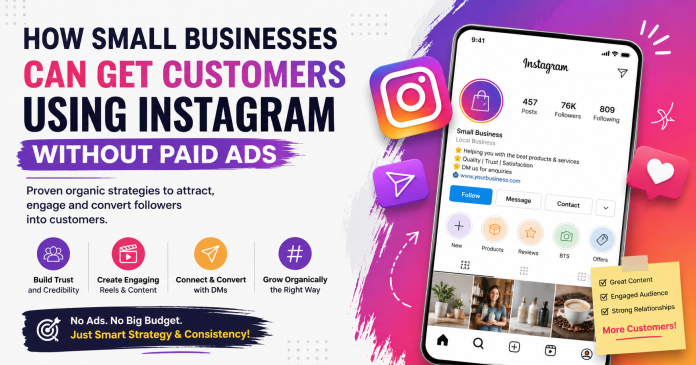
Meta Title: How Small Businesses Can Get Customers on Instagram Without Ads
Meta Description: Learn how small businesses can get customers from Instagram without paid ads using Reels, Stories, content marketing, hashtags, DMs, and organic growth strategies.
Suggested URL Slug: instagram-customers-without-paid-ads
Primary Keyword: get customers on Instagram without paid ads
Secondary Keywords: Instagram marketing for small business, organic Instagram marketing, Instagram growth, Instagram customers, Instagram marketing strategy
Introduction
For small businesses, getting new customers does not always require a large advertising budget.
Instagram has become one of the most useful platforms for businesses that want to build visibility, communicate with potential customers, showcase their products or services, and generate enquiries organically.
Whether you run a local shop, restaurant, salon, consultancy, service business, online store, educational business, professional service, or personal brand, Instagram can become an important customer-acquisition channel.
The key is to stop treating Instagram only as a platform for posting attractive photos.
Instagram should be treated as a marketing and customer-conversion channel.
With the right strategy, small businesses can use organic content, Reels, Stories, comments, direct messages, collaborations, and customer-generated content to attract potential customers without spending money on advertisements.
In this guide, we will explore practical ways to get customers from Instagram without paid ads.
1. Optimize Your Instagram Business Profile
Before trying to attract customers, make sure your profile clearly communicates what your business does.
When someone discovers your Instagram account, they should understand within a few seconds:
- What do you offer?
- Who do you serve?
- Where are you located?
- Why should they follow or contact you?
- How can they buy or enquire?
Your profile should include:
A clear profile photo:
Use your business logo or a professional image that represents your brand.
A simple username:
Keep it easy to remember and closely related to your business name.
A useful bio:
Instead of simply writing “Best quality products,” explain what you actually offer.
For example:
Helping small businesses build professional websites
Affordable website solutions for startups
📍 Delhi | 📩 DM for consultation
A clear call-to-action:
Tell visitors what you want them to do.
Examples include:
- DM us for details
- WhatsApp us for orders
- Book a consultation
- Visit our store
- Check our website
Your Instagram profile is effectively your mini landing page, so make it customer-focused.
2. Create Content That Solves Customer Problems
One of the biggest mistakes businesses make on Instagram is talking only about themselves.
Posting:
“Buy our product.”
“Our service is the best.”
“Contact us today.”
repeatedly can make your content feel like advertising.
Instead, create content that helps your target audience.
For example, a clothing business could post:
- How to choose the right size
- How to style one outfit in different ways
- Common fashion mistakes
- Seasonal outfit ideas
- Fabric-care tips
A digital agency could post:
- Website mistakes businesses should avoid
- SEO tips for beginners
- Social media marketing ideas
- Common online-business mistakes
- AI tools businesses can use
A restaurant could post:
- Food preparation videos
- Behind-the-scenes content
- Customer favourites
- Food pairing ideas
- Chef recommendations
The principle is simple:
Give people a reason to follow you before asking them to buy from you.
3. Use Instagram Reels for Organic Reach
Reels can be one of the most effective formats for reaching people who do not already follow your account.
You do not need expensive equipment to create useful videos.
A smartphone, good lighting, clear audio, and a useful idea can be enough.
Reel ideas for small businesses
Try creating:
- Quick tips
- How-to videos
- Before-and-after videos
- Product demonstrations
- Frequently asked questions
- Behind-the-scenes videos
- Customer stories
- Industry tips
- Mistakes to avoid
- Myth vs. fact videos
- Step-by-step tutorials
For example, a bakery could create a Reel showing how a popular product is prepared.
A plumber could demonstrate three common plumbing problems.
A real-estate consultant could explain what first-time property buyers should check before purchasing.
A fitness professional could demonstrate common exercise mistakes.
The objective is not simply to make a Reel.
The objective is to make content that your potential customer finds useful enough to watch, save, share, or send to someone else.
4. Create Content Around Customer Questions
Your customers are constantly asking questions.
Those questions can become your content calendar.
Make a list of questions customers ask before purchasing your product or service.
For example:
- How much does it cost?
- How long does delivery take?
- Which product should I choose?
- Is installation included?
- What is the difference between these two options?
- Can I return the product?
- Is this suitable for beginners?
- How does the service work?
Turn each question into a post, Reel, Story, or carousel.
This strategy has two advantages.
First, you create content that is directly relevant to potential customers.
Second, you demonstrate your expertise.
Over time, your Instagram account can become a useful resource in your industry.
5. Use Instagram Stories Every Day
Reels can help you reach new people, while Stories can help you build relationships with existing followers.
Small businesses should use Stories regularly instead of posting only when they have something to sell.
Story ideas include:
- New products
- Daily updates
- Behind-the-scenes moments
- Customer reviews
- Polls
- Questions
- FAQs
- Product demonstrations
- Limited offers
- Team introductions
- Business milestones
Interactive features such as polls and question stickers can also encourage followers to participate.
For example:
Which product should we launch next?
or:
What is your biggest problem with social media marketing?
The responses can provide valuable customer insights.
6. Turn Customer Reviews Into Content
People trust businesses more when they can see evidence that other customers have had a positive experience.
If customers give you permission to use their feedback, turn testimonials into Instagram content.
You can create:
- Testimonial graphics
- Customer-story Reels
- Before-and-after posts
- Screenshot-based testimonials
- Video reviews
- Case studies
Instead of simply saying:
“We provide excellent service.”
show the actual customer experience.
For service businesses, case studies can be especially powerful.
Explain:
Problem → Solution → Result
This gives potential customers a clearer understanding of the value you provide.
7. Use Local Instagram Marketing
If your business serves a specific city or area, local marketing can be extremely valuable.
Mention your location naturally in your content.
For example:
Best home-cleaning tips for Delhi families
or:
Things to check before renting a shop in Noida
or:
How to choose a wedding photographer in Gurgaon
You can also create content related to local events, communities, neighbourhoods, and customer experiences.
This helps make your content more relevant to people who are actually capable of becoming customers.
For local businesses, the objective is not necessarily to reach millions of people.
Reaching the right 1,000 people can be more valuable than reaching the wrong 100,000.
8. Use Hashtags Strategically
Hashtags should support your content strategy rather than replace it.
Instead of using a random collection of popular hashtags, use hashtags relevant to:
- Your industry
- Your product
- Your service
- Your target audience
- Your location
- Your niche
For example, a Delhi-based bakery could combine broader and more specific terms related to baking, cakes, desserts, and Delhi.
Avoid relying on extremely broad hashtags that have little connection to your target customer.
The goal is relevance, not simply quantity.
9. Engage With Your Potential Customers
Instagram is a social platform, so businesses should actually be social.
Spend time responding to:
- Comments
- Story replies
- Direct messages
- Questions
- Mentions
- Relevant conversations
You can also participate in conversations around your industry.
For example, if you sell business software, engage with content where entrepreneurs are discussing productivity or business challenges.
However, avoid aggressive commenting such as:
“Buy from us!”
Instead, contribute something useful.
Good engagement can create familiarity and eventually lead to enquiries.
10. Convert Followers Into Customers Through DMs
Getting followers is not the final goal.
Getting qualified enquiries and customers is.
Use your content to encourage meaningful conversations.
For example:
Want the complete checklist? DM “CHECKLIST”.
or:
Send us “PRICE” for the current pricing details.
When someone sends a message, don’t immediately send a sales pitch.
First understand what they need.
A simple conversation can be:
Business: Thanks for messaging us. What are you looking for?
Customer: I need a website for my business.
Business: Great. What type of business do you operate?
This allows you to understand the customer before recommending a solution.
11. Collaborate With Other Small Businesses
You do not need a huge influencer to grow your Instagram presence.
Look for complementary businesses that target a similar audience.
For example:
- Photographer + wedding planner
- Bakery + event planner
- Clothing store + jewellery business
- Real-estate agent + interior designer
- Fitness coach + nutrition professional
- Web designer + digital marketer
You can collaborate through:
- Joint Reels
- Live sessions
- Giveaways
- Educational content
- Interviews
- Cross-promotions
The important thing is to find relevant audiences, not simply large audiences.
12. Show the People Behind Your Business
Customers want to know who they are buying from.
Small businesses have an advantage here because they can often communicate more personally than large corporations.
Show:
- Founder stories
- Team members
- Daily operations
- Product creation
- Office or store life
- Business challenges
- Milestones
- Customer interactions
Authentic behind-the-scenes content can make your business more relatable.
People don’t only buy products.
They buy trust, convenience, experience, and confidence.
13. Create a Simple Instagram Content Formula
You don’t need to reinvent your strategy every day.
A simple content mix can make content creation easier.
Try dividing your content into four categories:
40% — Educational Content
Teach your audience something useful.
30% — Engagement Content
Ask questions, create polls, start conversations, and encourage opinions.
20% — Social Proof
Show testimonials, reviews, case studies, and customer experiences.
10% — Promotional Content
Talk directly about your products, services, offers, or bookings.
The exact percentages do not need to be followed rigidly. The important idea is to maintain a balance between value, engagement, trust, and promotion.
14. Follow the 3-Step Customer Journey
Your Instagram strategy should move people through three stages:
Stage 1: Discovery
People discover your business through Reels, shares, search, collaborations, or recommendations.
Stage 2: Trust
They visit your profile, watch your content, read reviews, and learn about your business.
Stage 3: Conversion
They send a DM, visit your website, call your business, visit your store, or make a purchase.
This means every piece of content does not need to generate an immediate sale.
Some content creates awareness.
Some creates trust.
Some generates conversion.
Together, they create a customer-acquisition system.
15. What Not to Do on Instagram
Avoid these common mistakes:
Buying followers
Fake followers do not automatically become customers and can make your audience data less useful.
Posting only promotional content
Constant selling can reduce engagement and trust.
Copying competitors
Study competitors for ideas, but develop your own voice and expertise.
Ignoring comments
A comment can become the beginning of a customer conversation.
Posting inconsistently
You don’t need to post ten times every day, but you do need a sustainable publishing routine.
Focusing only on likes
Likes are only one metric.
Pay attention to:
- Shares
- Saves
- Profile visits
- Website clicks
- DMs
- Enquiries
- Leads
- Sales
Ultimately, business outcomes matter more than vanity metrics.
A 30-Day Organic Instagram Plan
If you are starting from scratch, use the following framework.
Week 1: Build the Foundation
- Optimize your profile
- Define your target customer
- Create three content categories
- Prepare your first batch of posts
- Add a clear call-to-action
Week 2: Start Publishing
Publish a combination of:
- Reels
- Carousels
- Stories
- Educational posts
Respond to every relevant comment and message.
Week 3: Increase Engagement
Start:
- Polls
- Q&A Stories
- Customer testimonials
- Behind-the-scenes content
- Industry conversations
- Relevant collaborations
Week 4: Focus on Conversion
Review which content generated:
- Profile visits
- DMs
- Website clicks
- Enquiries
- Leads
Then create more content based on what performed best.
The objective is to build a repeatable system rather than chase one viral post.
How Long Does It Take to Get Customers From Instagram?
There is no guaranteed timeline.
Some businesses may receive enquiries quickly, while others may need months of consistent content and relationship building.
Results depend on factors such as:
- Industry
- Location
- Product or service
- Pricing
- Content quality
- Audience
- Competition
- Consistency
- Customer trust
Organic Instagram marketing should therefore be treated as a long-term customer-acquisition strategy, not a shortcut.
Final Thoughts
Small businesses do not necessarily need a large advertising budget to use Instagram effectively.
The real opportunity is to build an audience around useful content, demonstrate expertise, create trust, communicate with potential customers, and make it easy for interested people to take the next step.
Start with a clear profile.
Create content that solves real problems.
Use Reels to reach new audiences.
Use Stories to build relationships.
Use testimonials to establish credibility.
Use DMs to start conversations.
Use collaborations to reach relevant audiences.
And most importantly, measure enquiries and customers, not just followers.
Instagram works best when it becomes more than a place where your business posts content.
Build an Instagram presence that helps people discover you, trust you, and ultimately choose your business.